Photography and the Interpretation of the World —— Reflections Inspired by Reading Hockney on Art
Recently, I began reading Hockney on Art, a collection of conversations between David Hockney and Paul Joyce.
Early in the book, I was struck by a sentence from Joyce’s introduction:
“We know that anyone can pick up a camera, and most people do at some time, but it takes an artist to use a camera as an artist to interpret the world.”
As I continued reading, I was surprised by how deeply I resonated with Hockney’s ideas. His account of how the Joiners came into being reminded me of the origins of my own first experimental photographic work.
About seven years ago, I visited a photography exhibition at the San Francisco Museum of Modern Art (SFMOMA). In one of the galleries hung several images of iconic landmarks—the Eiffel Tower, the Golden Gate Bridge, Tiananmen Square, and others. These were not conventional photographs. Instead, they were composed of countless images layered and merged together. The landmark remained the visual anchor at the center, while the surrounding space seemed to unfold across time.
I no longer remember the photographer’s name, but I vividly remember the impact those images had on me.
What fascinated me was not the technique itself, but an idea:
A photograph could reveal multiple perspectives of the same subject at once, much like a Cubist painting by Picasso.
When I returned home, I began experimenting. I photographed the same subject from different angles, distances, and moments, then combined those images into a single composition. One of those experiments became the image below—a reinterpretation of the Golden Gate Bridge.
最近在读 David Hockney 与 Paul Joyce 的对谈集《Hockney on Art》。书刚翻开不久,就被 Paul Joyce 引言中的一句话吸引:
“任何人都可以拿起相机,但只有艺术家才能以艺术家的方式使用相机,去诠释这个世界。”
越往下读,越惊讶于自己能与Hockney产生这么多的共鸣。他的Joiner摄影拼贴想法的产生过程让我想起了自己第一张实验性摄影作品的诞生过程。
大约七年前,我在旧金山现代艺术博物馆(SFMOMA)看过一个摄影展。在一个小展厅里挂着几幅关于世界著名地标的作品。埃菲尔铁塔、金门大桥、天安门……画面并不是传统意义上的风景照片,而是由无数照片叠加融合而成。位于画面中心的地标依然是最醒目的,但周围的空间仿佛在时间轴上被展开了。
我记不清摄影师是谁,却清楚地记得当时受到的震动和启发:一张照片,可以同时展示一个物体的多个视角,就像毕加索的立体主义画作。
回家之后,我开始尝试围绕同一个对象,从不同角度、不同距离、不同时间进行拍摄,再将这些影像组合在一起。后来便有了下面这张关于金门大桥的实验作品。
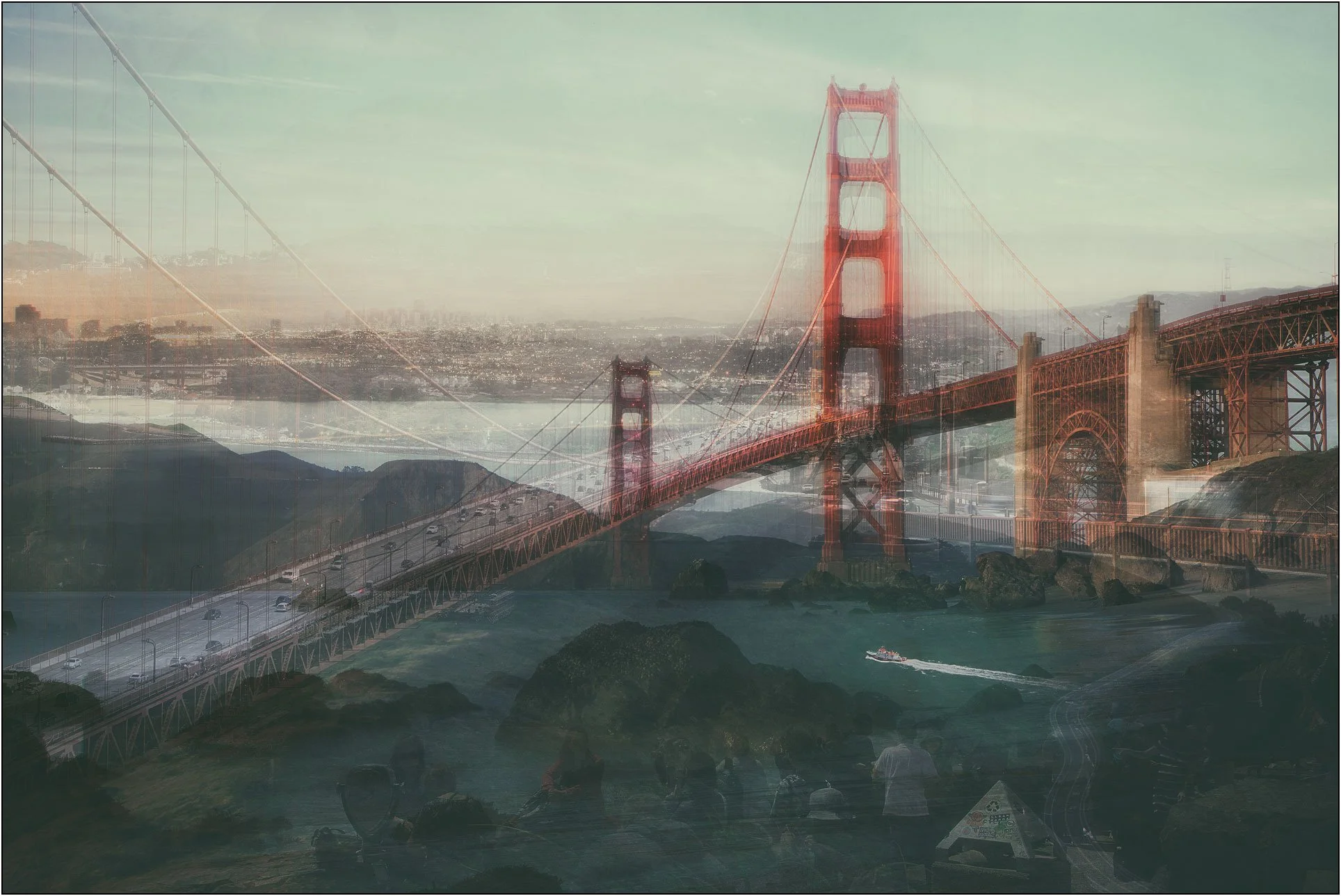
Experience with Golden Gate Bridge
Only recently, while reading Hockney, did I realize that what had truly attracted me back then was not a visual effect, but a question about seeing.
Hockney has often expressed admiration for the spatial concepts found in traditional Chinese painting. He argues that the fixed viewpoint of photography does not reflect how we actually experience the world. We do not see as a camera sees. We move, pause, look back, remember, and connect. Our understanding of a place is continually shaped through movement, memory, and time. In other words, our experience of the world already contains the flow of both space and time.
Looking back, that photograph of the Golden Gate Bridge was a sincere attempt to capture not only the appearance of a place, but my experience of it—not just a single view recorded from a particular vantage point, but something closer to how the place existed in my memory.
At that point, I felt a strong desire to rediscover the photographer whose work had influenced me so deeply. After spending quite some time searching through old photographs on my backup disks, I finally found the exhibition label and the artist’s name: Corinne Vionnet.
I also found the accompanying exhibition text.
And then I realized something unexpected.
I had, in a sense, misunderstood her work.
Vionnet’s Photo Opportunities series was not created by photographing landmarks from multiple viewpoints. Instead, she collected thousands of tourist photographs from the internet and layered them together. Her question was different:
Why do people from around the world stand in almost the same place and take almost the same picture?
She was exploring a form of collective vision.
What I took away from her work, however, was something entirely different:
Could a single photograph bring together multiple perspectives of a subject—and multiple experiences of the photographer?
Years later, I realized that the exhibition had left me not with an answer, but with a question.
Perhaps that is one of the most remarkable things about art. Art does not necessarily transmit an artist’s ideas intact from creator to viewer. Instead, it sparks new questions in the viewer’s mind. Those questions may lie dormant for years before resurfacing and revealing their significance.
Over the years, I have continued creating work that explores this way of seeing and interpreting the world. Some of these photographs are now included in my Ethereal series here.
直到最近读霍克尼,我忽然意识到,当年真正吸引我的并不是某种视觉效果,而是一个关于观看的问题。
霍克尼非常认同中国传统绘画的透视观念,他认为,摄影的单一视点并不符合人类真实的观看经验。我们并不是像镜头那样静止地观察世界,而是在移动、停留、回望与记忆中不断构建对世界的理解。换句话说,我们体验到的世界本来就包含时间和空间的流动。
当年那张金门大桥作品,其实正是一次真诚的尝试。我想把自己对一个地方的体验,而不仅仅是站在某个机位用相机拍的一个视角,放进一张照片里。
我突然想找出这位对我影响深远的摄影师的名字,再去网上搜索和学习她的作品,于是我花了很久的时间找到了当年在展馆拍的手机照片,找到了那位摄影师的名字:Corinne Vionnet,以及展品简介。
有趣的是,我发现自己当年似乎“误读”了她的作品。
Vionnet 的《Photo Opportunities》系列并不是她围绕地标进行拍摄,而是从网络上收集成千上万张游客照片,再将它们叠加融合。她关注的问题是:为什么来自世界各地的人,会站在几乎相同的位置打卡,拍摄几乎相同的照片?
她研究的是一种集体观看。
而我当年从作品中读到和思考的,是一张照片是否可以同时融合物体的多个视角和摄影师的不同体验?
多年以后回头看,我才发现,那次展览真正留给我的并不是答案,而是问题。
艺术作品最神奇的地方,也许正在于此。它并不一定把艺术家的思想原封不动地传递给观众,而是在观众心中激发出新的问题。那些问题有时会沉睡很多年,直到某一天再次被唤醒。
这些年,我也尝试创作更多表达这种观看与诠释方式的作品。其中一些作品现在被归入我网站中的 Ethereal 系列。
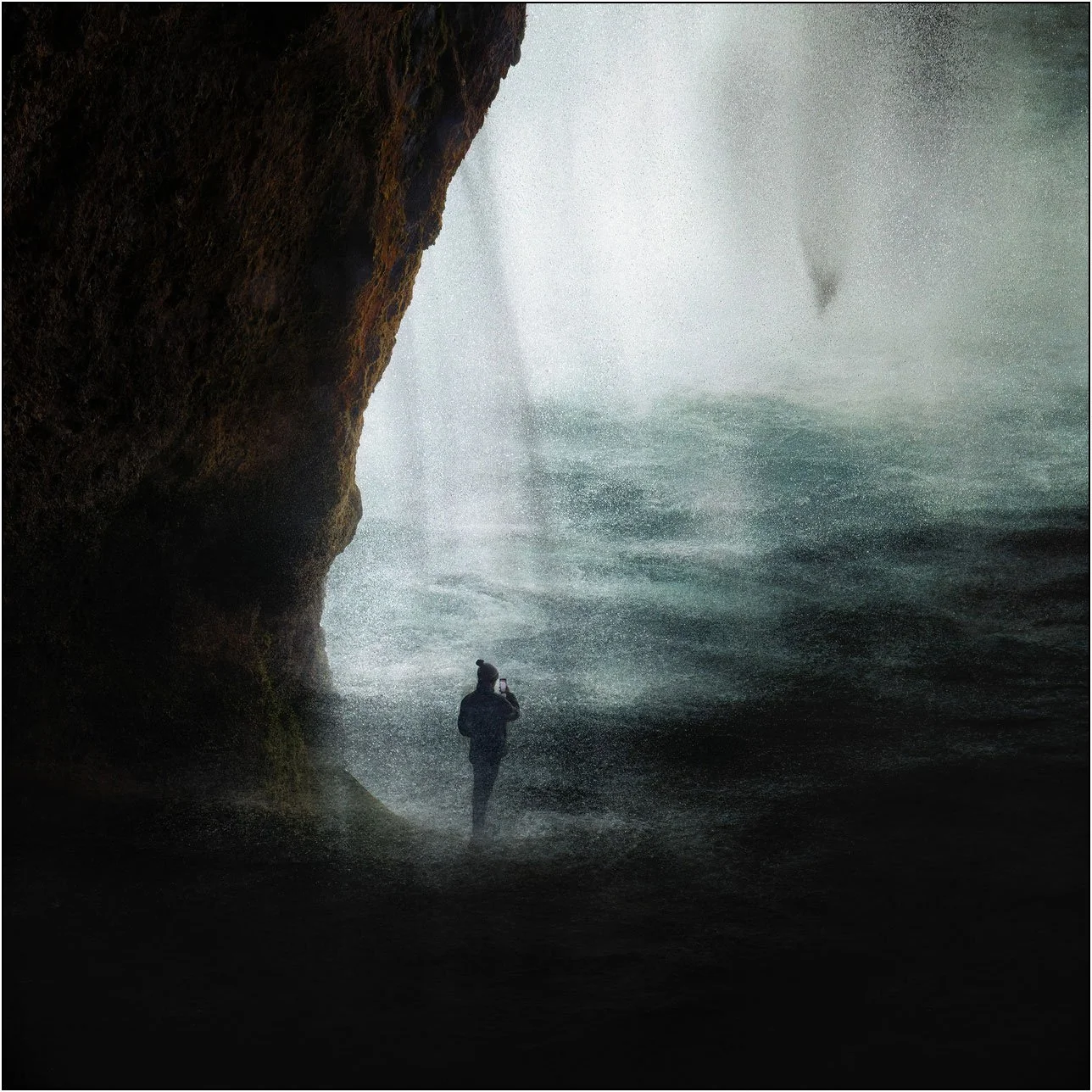
Seljalandsfoss (Iceland) reconstructed from different angles.
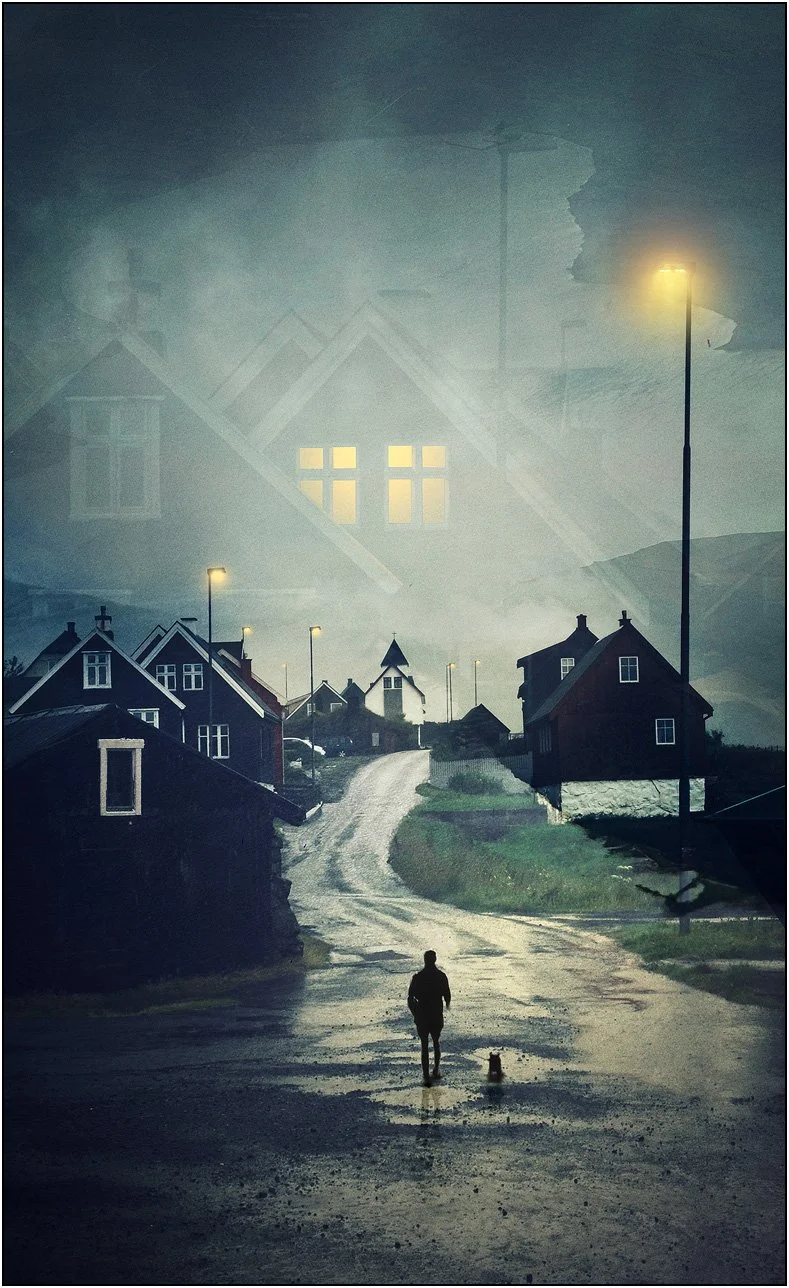
Faroe Islands village in my memory.
From that early experiment with the Golden Gate Bridge to many later projects, I have gradually come to understand that my interest has never been photography as a means of recording the world. Rather, it has been photography as a way of helping us see and interpret the world anew.
Reading Hockney today, I feel as though I have finally found a language for something I have been exploring for years. There is a sense of resonance, an awareness of shared starting points expressed through different artistic approaches, and the excitement of finding oneself in conversation with a great artist across time.
Looking back, the photographer, the exhibition, the image, and the book I encountered seven years later all seem connected by an invisible thread.
And the beginning of that thread was not a mere photograph.
It was a way of seeing the world that I have been trying to understand all these years.
从那张金门大桥开始,到后来各种创作尝试,我越来越意识到,自己感兴趣的或许从来都不是摄影如何记录世界,而是摄影如何让我们重新观看和诠释眼前的世界。
读到霍克尼时,我仿佛终于找到了一种语言,去描述这些年一直在探索的东西。有共鸣,有不同表达手段背后的相同出发点,也有一种与大师隔空对话的兴奋。
回头看,那位摄影师、那次展览、那张照片,以及七年后读到的这本书,似乎都被一条看不见的线连接在一起。
而这条线的起点,并不只是一张照片。
而是我这些年来一直在摸索的一种观看世界的方式。